The Facts
The facts about how WBC programs work, where the money goes, and what Wyoming gets in return.
TRANSPARENCY + ACCOUNTABILITY
Economic development is complicated enough that mischaracterizations happen easily. We believe in straight talk and hard facts — so here’s what’s true about how WBC programs work, how funds are managed, and what Wyoming gets in return.
This page is designed to move past common misconceptions and provide the factual reality of how state investments are managed, how taxpayer dollars are protected, and how — together — we are building a Wyoming where our youth can choose to stay and thrive.
REALITY CHECK
We welcome scrutiny. In 2026, the Wyoming Department of Audit completed a review of nearly seven years of WBC operations as requested by the Wyoming Legislature. The findings: no material misstatements, no improper spending, no violations of Wyoming law — and one minor documentation note involving less than $850 across thousands of transactions. Independent review is how accountability works, and we’d put this record up against any state agency.
Wyoming Supports Growth
The Wyoming Business Council conducted a statewide poll with support from a third-party research partner, The Tarrance Group, measuring voter attitudes on economic conditions, development priorities, and community growth. The results reveal a strong mandate for proactive, community-led growth and a clear consensus on the urgent need to retain our young people to build resilient communities.
The survey of 514 registered voters, conducted Sept. 20–24, 2025, paints a picture of a state that is pragmatic yet fundamentally optimistic. While residents acknowledge economic headwinds, they are ready to roll up their sleeves and build a stronger future, expecting their local leaders and private sector partners to lead the charge.
MYTH BUSTING
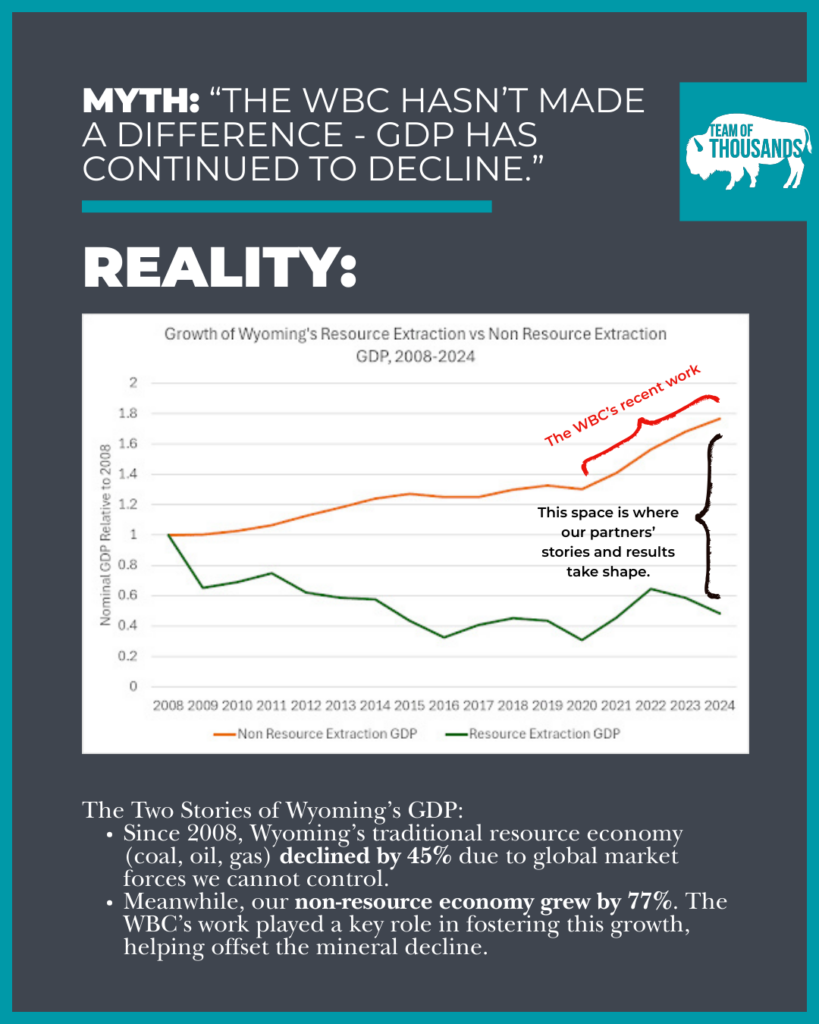
Myth: “The WBC has spent $1 billion, yet Wyoming’s GDP is stagnant or declining.”
Reality: Our non-mineral economy is actually growing, and the state is successfully diversifying.
- The Two Stories of Wyoming’s GDP: Since 2008, Wyoming’s traditional resource economy (coal, oil, gas) declined by 45% due to global market forces we cannot control. Meanwhile, our non-resource economy grew by 77%. The WBC’s work played a key role in fostering this growth, helping offset the mineral decline.
- Investing in Ourselves: Between 2021 and 2025, the WBC invested $65.7M in community infrastructure. These investments, paired with federal venture capital (WYVC), created an estimated $2 billion in economic impact and generated $53.5 million in tax revenue to fund our schools and roads.
- Building New Engines: We are seeing real, measurable gains in Healthcare, Tourism, Professional Services, and Manufacturing. Strategic investments (like pipes, power, and R&D) are what unlock private money, creating the high-quality jobs that keep our young people in Wyoming.
The Bottom Line: While global markets have hit our mineral sector hard, Wyoming’s non-resource economy grew by 77% in the same timeframe. We aren’t just spending money; we are building the new engines of growth – like manufacturing and tech – that are successfully filling the gap left by declining coal and oil revenues. Learn more about the WBC’s impact on our Resources page.
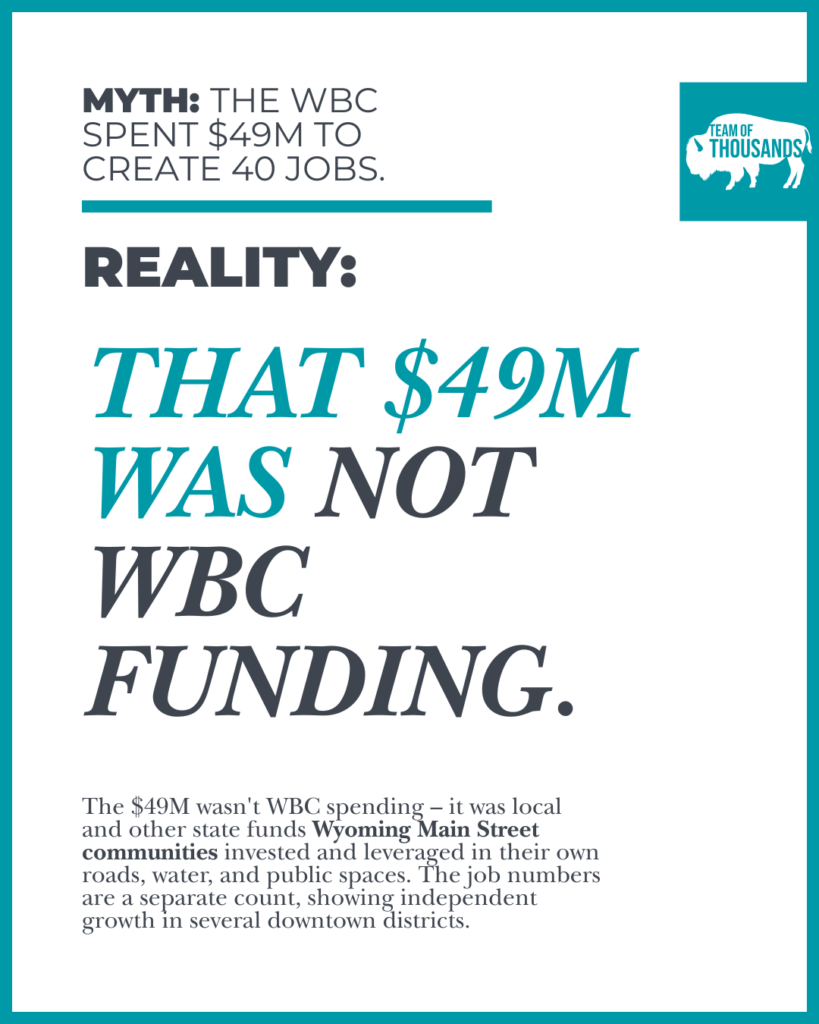
Myth: “The WBC Spent $49 Million to Create Only 40 Jobs.”
Reality: This is a misrepresentation of two unrelated statistics.
- None of it was WBC Money: The $49 million figure comes from a 2024 Wyoming Main Street report. That money was not spent by the WBC; it reflects the total investment local cities, counties, other state agencies, and the federal government chose to make in their own communities for things like road resurfacing, sewer upgrades, and building repairs.
- The Numbers are Not Tied Together: It is a mistake to divide the spending by the job count. The “40 jobs” is a separate, self-reported win from a handful of downtown districts. These two numbers describe different activities and were never meant to be linked as a “cost-per-job” metric.
- Communities Investing in Themselves: This $49 million actually tells a positive story: Wyoming towns are taking the initiative to fix their own infrastructure to make their downtowns better places for businesses to thrive and families to enjoy.
The Bottom Line: Wyoming Main Street is an educational tool and an economic strategy for downtown improvement; it is not a direct “cost-per-job” program. Learn more at wyomingmainstreet.org.
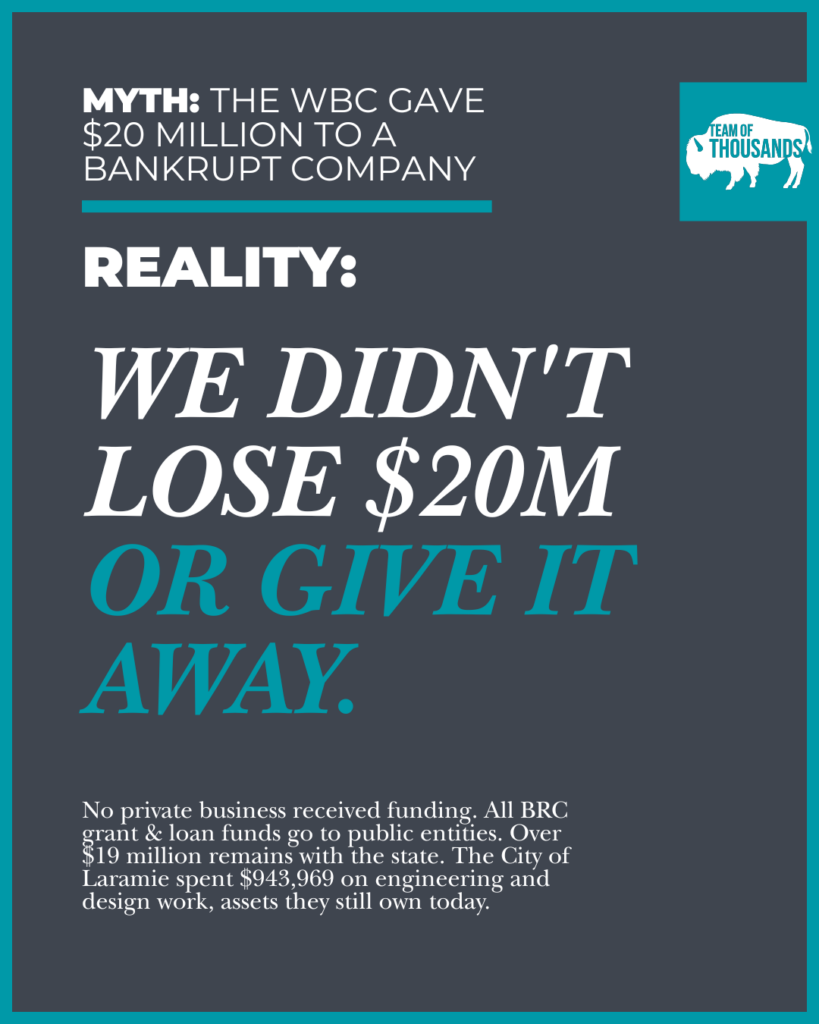
Myth: “The WBC gave $20 million in taxpayer grants to a private company that went bankrupt.”
Reality: The WBC invests in public infrastructure, not private bank accounts.
- Statutory Fact: 100% of Business Ready Community (BRC) grants and loans go to public entities (cities, towns, counties, joint powers boards, and tribes) to meet their identified needs.
- Public Ownership: The public owns the resulting asset (roads, pipes, buildings). If a business leaves, the city still owns the improved land and infrastructure to attract the next one.
- Safety Net: Funds are paid on a reimbursement basis. In the “Project Jupiter”/Plenty case, because the project stopped, $19 million was never spent and remains in state accounts for future projects.
- Community Asset: The $944,000 the City of Laramie spent on design and engineering is an asset the city owns and can use to attract another business.
The Bottom Line: No private company received $20 million. The public owns the infrastructure. Taxpayer money stayed protected through reimbursement-only payments and remained in state accounts when the project ended. Learn more about the Business Ready Community program.
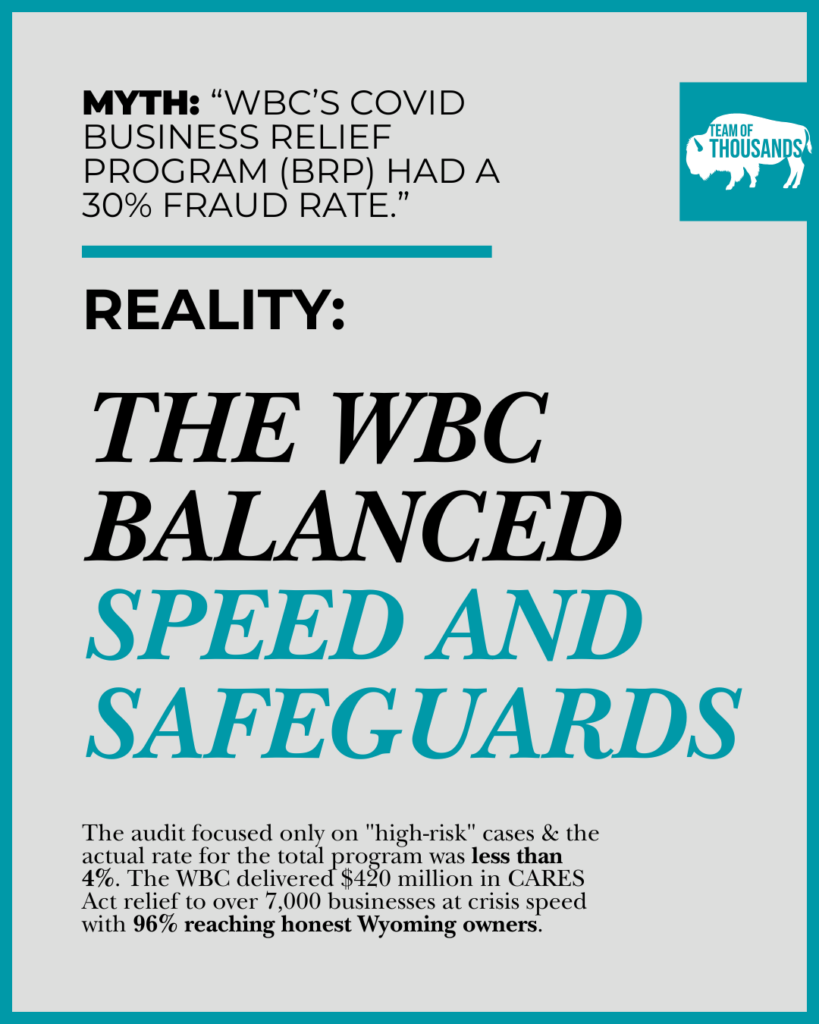
Myth: “WBC’s COVID Business Relief Program (BRP) had a 30% fraud rate.”
Reality: The audit focused only on “high-risk” cases; the actual rate for the total program was less than 4%.
- Prioritizing Speed for Wyoming Small Businesses: Following the Legislature’s direction in 2020, the goal was to get emergency relief to local businesses quickly so they could stay afloat and keep people employed. While speed increases risk, the WBC’s internal flagging system successfully identified the vast majority of errors and potential fraud for later recovery.
- Targeted Audits: The 30% figure comes from a group of 334 applications specifically flagged by the WBC and the Secretary of State as high-risk or suspicious. It was not a random sample of the whole program.
- The Real Number: Out of the $420 million in federal CARES Act funding distributed to over 7,000 Wyoming businesses, only 3.91% of the funds were required to be returned.
- Honest Mistakes vs. Fraud: Many of the findings were not intentional fraud, but rather legitimate small business owners who misunderstood complex federal rules during a crisis. The audit process allowed the state to recover those funds fairly.
The Bottom Line: Our flagging system worked. Nobody asked the WBC to do that, but we wanted to be good stewards of public money. By catching high-risk applications early, we ensured that 96% of the emergency relief went exactly where the Legislature intended: to local businesses in crisis.
Additional Myths vs. Reality
Myth: "The WBC picks 'winners and losers' or favors the well-connected."
Reality: We provide the level playing field that no single business can build alone.
- Enabling Conditions: We focus on infrastructure (roads, water, internet) and workforce – things a business needs to succeed but can’t necessarily build by itself.
- Open Process: All applications are reviewed in public meetings. We don’t “pick winners”; we ensure Wyoming towns are “ready to win” when a business looks at our state.
The Bottom Line: We don’t pick which business wins; we build the infrastructure that allows any business in a Wyoming town to have a fair shot at winning. Learn more about the WBC’s impact on our Resources page.
Learn more about the importance of public-private partnerships for business growth in Wyoming in this letter from Mesa Natural Gas Solutions.
Myth: "The WBC throws money around with little oversight or return."
Reality: The BRC program is a high-scrutiny investment process where the community, the WBC, and the State’s top leaders all have a seat at the table.
- Multi-Level Oversight: Every Business Ready Community (BRC) grant or loan project undergoes a series of rigorous reviews before a single dollar is committed.
- Projects Begin at the Local Level: Through a public process, communities work with their Regional Director to first identify a need, prove a project’s viability, and provide local match (skin in the game).
- WBC Technical Review: The WBC team performs site visits, financial audits, and third-party economic impact analyses.
- Public Board Scrutiny: Projects are debated in public meetings – including accepting public comment – by the WBC Board (private-sector experts) for a recommendation.
- Final SLIB Approval: The State Loan and Investment Board (SLIB) – composed of Wyoming’s five statewide elected officials – holds the final decision-making power on all funding.
- Pay-for-Performance: We do not cut checks upfront. BRC funds are released only as reimbursements after work is completed, inspected, and verified by invoices.
- High ROI & Repayment: For every $1 of combined public investment (state BRC grants/loans and federal WYVC funds), Wyoming sees nearly $25 in total economic activity. By using federal dollars to support high-growth startups and state funds to build the infrastructure they need to scale, we create a multiplier effect that benefits the entire state. Furthermore, many BRC investments are loans that must be repaid with interest, or grants with revenue recapture rules that return money to the state when the project succeeds.
The Bottom Line: WBC investments are designed for maximum accountability. With a multi-layered review process that ends with the State’s top five elected officials, we ensure every project is a calculated investment in Wyoming’s future. Learn more about the process in action with our How the Money Flows video or read the 2024 BRC Deep Dive.
Myth: "If banks won’t fund a project, the government shouldn't either. Grants are just lost money."
Reality: We bridge the gap for Wyoming-owned businesses so they don’t have to close.
- Banks Have Limits: Local banks often can’t lend on “goodwill” – the years of hard work a business owner has built up. Without a WBC Succession Loan, a retiring owner might have to close their doors because a loyal employee can’t get a bank loan to buy it. We bridge that gap to keep Main Street staples open.
- 0% Default Rate: Our 50/50 and Succession loan programs are designed to work with local banks, not against them. Since 2022, we have infused $25 million into small towns with a 0% default rate. These loans are repaid with interest, recycling the money to help the next entrepreneur.
- Grants Build Public Assets: BRC grants aren’t “lost money.” They go to cities and towns to build public infrastructure. If the project generates revenue, the city recaptures a portion of those funds to reinvest in the next local project. It is a profit-sharing model for the public.
The Bottom Line: We aren’t competing with banks; we are finishing the job they can’t. We help keep businesses in Wyoming hands and turn one-time grants into revolving local funds. Learn more about the WBC Loan Portfolio.
Myth: "The WBC funded a $23 million failed project at Cody Labs."
Reality: No expansion loan funds were ever lost, and the existing community asset remains protected.
- The Expansion Never Started: In 2014, the Legislature created the Wyoming Economic Development Large Project loan program (originally known as the “Cody Labs Bill”). While state officials approved $23 million in low-interest loans under this program for an expansion, the project was halted before it began. Zero dollars from this loan were ever paid out.
- The System Prevented Loss: This is a clear example of the WBC’s rigorous process working exactly as intended. By only releasing funds as specific milestones are met, the state ensured that when the company changed its plans, taxpayer money never left the bank.
- A Community Asset Remains: Long before the expansion was proposed, a separate Business Ready Community (BRC) grant helped the City of Cody build a warehouse facility in 2012. That asset is still owned by the city today (via Forward Cody).
- Ready for the Next Win: Because the community owns that original building, it continues to collect lease payments and serves as a “ready-to-go” tool to recruit new businesses to the area.
The Bottom Line: A headline about a “failed project” shouldn’t be confused with a loss of funds. The state’s milestone-based lending worked exactly as intended: no project, no payout.
Myth: "The Rock Springs First Security Bank project shows a misuse of taxpayer dollars."
Reality: The state stepped in to save a historic landmark that the private market couldn’t fix alone.
- Saving a Landmark: The First Security Bank building sat vacant and decaying for nearly 40 years. Because the cost of bringing such an old, historic building up to modern safety codes was so high, no private developer would touch it. The WBC grant was used to make the building safe and shovel-ready, so it could finally return to the tax rolls.
- A High-Risk Rescue: This was a complex structural project, not a simple remodel. Work began in 2020 and required the City to demolish an adjacent building just to gain access to the bank’s foundation. This access was essential for critical structural work and the installation of a modern elevator shaft.
- Overcoming the Pandemic: Like many projects started in 2020, this one faced massive COVID-related disruptions. The sharp rise in material and labor costs caused the project to exceed early estimates, a challenge felt by builders across the country.
- Accountability Through “Recapture”: This was not a gift. The grant includes a Revenue Recapture clause. Once the sale of the building is finalized, the City is required to repay a significant portion of the proceeds (currently set at 90% by the State Loan and Investment Board) back to the state’s grant fund to be reinvested elsewhere.
- Spurring Downtown Growth: By stabilizing this anchor building, the state helped revitalize downtown Rock Springs, turning a 40-year liability back into a center for business
The Bottom Line: We don’t just give money away – we bridge the gap to help save community anchors. In this case, the state investment helped lessen the local risk of a failing historic building so that it could be safely handed back to the private sector.
Myth: "The WBC is using state money to build affordable housing."
Reality: We build the “road to the house,” not the house itself.
- Infrastructure Only: The WBC has never funded a housing project. We fund the public infrastructure (water lines and streets) required to make a housing site viable for a private developer to step in.
- Removing Barriers to Growth: The WBC also works with Wyoming communities to identify local housing regulations that act as roadblocks. By stripping away outdated rules that make building too slow or too expensive, towns like Cheyenne have seen major success – more than doubling their usual number of building permits in a single year.
- Assessment to Action (A2A): Through our A2A coaching program, we help local leaders identify their “single binding constraint.” For many, this means updating zoning and permit processes so the private market can finally meet the demand for new homes.
The Bottom Line: We solve the infrastructure and regulatory hurdles that make housing too expensive to build. We work with local communities to fund the pipes and pavement and help simplify the rules so the private sector can provide the homes Wyoming families need. Learn about statewide efforts to address Wyoming’s housing challenge at wbc.pub/Housing.
Myth: "Cutting the WBC would significantly shrink the state budget and bureaucracy.”
Reality: Cutting the WBC removes a revenue generator, not just a cost.
- Tiny Footprint: The WBC represents less than one-half of one percent (0.49%) of the state budget.
- Revenue Source: WBC programs generate 65 cents in new tax revenue for every dollar invested. Cutting the agency doesn’t just save a few pennies; it eliminates the millions in tax revenue those programs bring in to fund schools and roads.
The Bottom Line: Cutting the WBC doesn’t fix the budget; it shrinks the tax base. For a cost of less than 0.5% of the budget, we bring in millions that fund our schools and roads. Learn more about the WBC’s impact on our Resources page.
WBC CEO, Josh Dorrell, headlined a Wyoming Tax Facts Lunch & Learn webinar where he candidly discussed Wyoming’s shrinking economy and the path to better opportunities for businesses, workers, families, and future generations. Throughout the presentation, he busted some common myths about Wyoming’s economy.
Watch the recording and let us know what you think of the bold alternatives the WBC is proposing to make our resilient vision for the Cowboy State a reality.