Events & Activities
Actively building Wyoming’s future together.
ARCHITECTS IN ACTION
Economic growth doesn’t happen in a vacuum — it happens in our coffee shops, town halls, and local boardrooms. At the Wyoming Business Council, we believe the best way to predict the future is to build it ourselves. This page is your hub for the Team of Thousands to move beyond the headlines and into the work. From our ‘Building Wyoming’s Future’ community conversations to hands-on workshops like ‘Assessment to Action,’ we are creating spaces where every Wyomingite can help solve local problems and capture statewide opportunities.
We’re just getting started. This is a living list of events designed to empower you with data, connect you with experts, and give you a seat at the table. Check back often, join the dialogue, and stay tuned —more ways to take action for your community are coming soon!
What’s the Point? Open Mic

YOU HAVE QUESTIONS.
WE HAVE ANSWERS.
Wyoming’s economic future is at a crossroads, and we know there are a lot of questions about what comes next. Join Business Council CEO Josh Dorrell every week for a live, unscripted Q&A. From the proposed dismantling of the WBC to how we’re fighting to keep Wyoming families whole, no question is off-limits. Get the facts, join the conversation, and find out how you can take action for your community.
- Next Session: Tuesday, Feb. 3, 2026 @ 1 PM MST
- Open to the public
- All sessions will be recorded and posted here
Open Mic Recordings
Wyoming’s economic crossroads are too important for closed-door conversations. If you couldn’t join us for our latest “What’s the Point?” Open Mic, you can watch the full, unscripted recordings here. From debunking myths about the WBC budget to discussing the future of our local communities, we’re putting it all on the table. Watch CEO Josh Dorrell tackle the tough questions and get the facts you need to be an informed advocate for your region.
Building Wyoming's Future
The WBC is hosting a series of essential community conversations exploring Wyoming’s biggest economic growth hurdles and opportunities, and discussing practical steps needed to secure a thriving, resilient future for generations to come.
These conversations are vital for everyone in our Team of Thousands – local leaders, business owners, students exploring opportunities to stay in Wyoming, and dedicated citizens – who want to play a direct role in building a thriving, resilient future for generations to come.
JOIN US FOR OUR NEXT COMMUNITY CONVERSATION
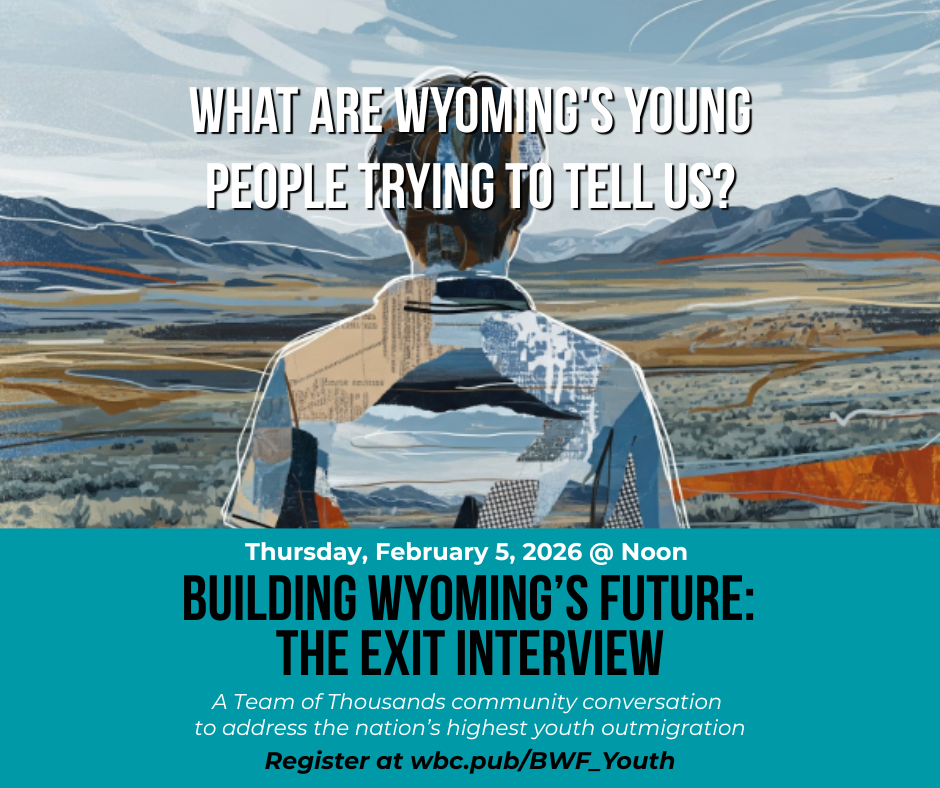
BUILDING WYOMING’S FUTURE: THE EXIT INTERVIEW
Wyoming leads the nation in exporting its greatest resource: our children. With 60% to 70% of our youth leaving the state by age 30, we are facing an existential threat to our families and our future. Join the Wyoming Business Council, ENGAGE, and WyoFile for a candid “Exit Interview” to hear directly from young Wyomingites. This isn’t a panel of experts talking about young people; it’s an authentic dialogue featuring those who stayed, those who left, and those weighing their options today.
Whether you are a parent, employer, or policymaker, this conversation is a vital step in moving beyond assumptions and listening to the voices that will shape our state’s tomorrow. Your participation will help ensure we are building a Wyoming where the next generation can thrive.
Tune in Thursday, Feb. 5, 2026, at Noon MST
PAST CONVERSATIONS & RECORDINGS
BUILDING WYOMING’S FUTURE: UNDERSTANDING THE NUCLEAR INDUSTRY
The first of our community conversations explores how major new developments – such as the proposed BWXT nuclear facility near Gillette, Wyoming – can serve as powerful catalysts for statewide economic growth and opportunity. Watch the conversation with Business Council CEO Josh Dorrell and community and industry leaders.
BUILDING WYOMING’S FUTURE: CRITICAL MINERALS BEYOND THE ROCKS
The second community conversation in our “Building Wyoming’s Future” series generated crucial discussion on how Wyoming can strategically capitalize on its rich resource base to create new, lasting economic clusters.
Wyoming’s Advanced Nuclear Opportunity: Community Q&A
How will BWXT ensure high-quality, long-term jobs rather than a short-term boom?
This is not a “boom-and-bust” model. It is a generational anchor industry, and key drivers include
- Decade-scale facility lifespan under NRC licensing
- Prioritizing local hiring and upskilling
- Building a strong, local supply chain
- Working with colleges and communities for ongoing workforce development
- Integrating into the community over a generation, not a project cycle
I’m a young Wyoming resident studying nuclear engineering with limited experience. How can I contribute to this state and to the nuclear field?
- Start with two steps: gain real-world experience and share what you know.
Seek internships or co-ops with BWXT, TerraPower, national labs, or engineering firms. Hands-on experience will matter as much as your degree. - Be a local “explainer.” Talk with friends, family, and community groups about what modern nuclear energy looks like today. Staying connected to Wyoming projects now will position you well as opportunities grow.
Gillette has a strong workforce from coal and industrial operations. How do these skills fit a TRISO fuel facility, and will training be provided?
- These existing skills and know-how fit very well. Skills from coal plants – maintenance, operations, safety, instrumentation, valves, pumps, quality – are directly relevant to a TRISO fuel facility.
- Training will be essential. We expect to develop targeted programs in partnership with Gillette College, the University of Wyoming, WyoTech, Wyoming Welding Academy, and employers like BWXT and L&H. The workforce that powered Wyoming’s legacy industries can transition into advanced nuclear with the right support.
What specific training could colleges offer to advance the nuclear workforce?
Training should be practical, employer-aligned, and accessible. Colleges can serve as a bridge between today’s skills and tomorrow’s jobs by offering a variety of training opportunities, including
- Certificates in nuclear quality, radiation protection, and process operations
- Short, stackable credentials in advanced manufacturing
- Co-developed courses with industry
- Built-in internships or co-op rotations
- Technical training tied directly to employer needs
Will BWXT or L&H partner with Gillette College, UW, or others to train Wyoming residents for TRISO manufacturing or microreactor work?
- Yes. Partnerships with local colleges and training providers are expected. These may include curriculum design, advisory roles, internships, apprenticeships, and on-site training to ensure Wyoming residents are first in line for these careers.
- L&H partners with Gillette and Sheridan College, UW, and many other community colleges, trade schools, etc. We get our best talent by working with the teachers and finding students who match our culture and fit in our mission, vision, and values. The world changes faster each year, so L&H looks for people who want to perpetually upgrade their skills, abilities, and opportunities. Training on the job is the norm for L&H.
How can we help K–12 students understand the career opportunities emerging in Wyoming?
The message to convey to our young people is simple: you can build your life here doing world-class work. We recommend introducing energy and advanced manufacturing careers early through:
- School visits from engineers, welders, and technicians
- Hands-on clubs (robotics, energy clubs, machining basics)
- Field trips to training centers or industrial sites
- Classroom kits that connect STEM skills to Wyoming jobs
- Teacher training and lesson plans tied to local industries
Can we bring nuclear education or training classes to Carbon County and other regions?
Yes. Regional interest makes this easier. Carbon County Higher Education Center and others can work with project partners to pilot short courses on nuclear fundamentals, safety, energy careers, and technical skills aligned to future jobs.
How can a small business get networked or involved with the advanced nuclear sector?
Small businesses in Wyoming are already winning major contracts, and more can join them. Visibility and clarity are key:
- Attend supply-chain tours and business roundtables
- Submit capability statements to BWXT, TerraPower, or other project partners
- Join networks like Wyoming Innovative Entrepreneurs
- Demonstrate quality, safety, and reliability even if not yet “nuclear-qualified.”
How can electrical professionals and technical organizations support nuclear development?
Organizations should connect with BWXT, L&H, local utilities, and training providers to align skills and pursue supplier or contractor roles. Electrical expertise is essential for:
- Power distribution
- Controls and instrumentation
- Grid interconnection
- Maintenance of industrial systems
If political opposition pushes advanced manufacturing away, will companies expand elsewhere?
- Yes. Companies investing hundreds of millions of dollars will go where they can operate with certainty, predictability, and a welcoming environment. We’ve already seen this happen with other companies looking to expand in Wyoming that opted to move elsewhere when policy did not support their needs, irrelevant of available investments.
- Wyoming earned early advantages by being unified and forward-looking. Losing that posture would put these opportunities at risk. Companies have been clear with state leaders: political instability or hostility will send projects – and jobs – elsewhere.
Is Wyoming’s legislative direction a concern if it favors “legacy industries” over advanced ones?
- It can be. Wyoming can – and should – support legacy and emerging industries simultaneously. But if policy signals that advanced manufacturing or next-generation energy are unwelcome, growth may shift elsewhere. Wyoming’s future depends on expanding the pie, not protecting slices.
- If a company or a state decides not to innovate or iterate, it suffers. The only guarantee in business and life is change. Not everyone wants it; some want things to stay the same or even return to the past—but that’s the one impossible thing. If we engage in change, we can help shape it and lead it. If we resist, we’ll be dragged into it anyway, without any of the rewards of being the creator or the leader. And remember: there’s room for all forms of energy. When any product or energy source hits peak demand and stops evolving, competition squeezes out the profits and eventually erodes wages and benefits. The path forward is to keep the profitable legacy industries while pushing into new products and services that aren’t price-sensitive. The right strategy is all of the above—and always moving forward.
As more industrial jobs come to Wyoming, how can local healthcare and community resources support workers and families?
Healthy workers and stable families strengthen long-term workforce retention. Support should be:
- Preventive: screenings, occupational health, heat, and respiratory monitoring
- Family-focused: child care, housing stability, mental health options
- Workforce-aligned: clinic hours that fit shift schedules
- Specialized: training providers in radiation medicine and emergency response (rarely needed, but important)
Can healthcare resources be tailored specifically for the nuclear sector to attract more investment?
Yes. Specialized clinical training, emergency preparedness, mental health support, and family services can all signal that the region is ready to support advanced industries. This is another competitive advantage communities can use to leverage themselves.
How will industry leaders maintain transparency, given past failures in other energy sectors?
Trust is built by inviting good faith scrutiny, not avoiding it. Transparency requires:
- Early and ongoing communication
- Plain-language explanations of safety and risk
- Independent oversight and regulatory rigor
- Willingness to share both successes and mistakes
- Community advisory groups with real access to information
What risks or challenges exist in bringing nuclear industries to Wyoming? What policies are important to ensure responsible development?
Responsible development means clear rules, enforced consistently, not no rules.
Potential key risks:
- Political volatility
- Public misinformation
- Workforce bottlenecks
- Infrastructure capacity
- Complex permitting
Important policies:
- Stable, predictable regulatory frameworks
- Proactive community engagement
- Workforce and education investment
- Infrastructure readiness
- Clear environmental and safety guardrails
Where can the public find unbiased information about nuclear impacts?
Look to independent and science-based sources, such as:
- National labs
- Universities
- Federal regulators
- Global case studies of long-standing nuclear communities
How should AI be discussed without using it only as a justification for power demand?
It should not be used as a buzzword or justification. The focus is the mission, not the hype. Instead, AI should be framed as a tool to solve real problems, such as:
- Predictive maintenance
- System optimization
- Advanced operator training
- Enhanced safety monitoring
- L&H uses AI to enhance the capabilities of our people, which expands the capabilities of the entire company. AI improves the speed and quality of my work as CEO and accelerates performance across the organization. At this point, it’s hard to imagine doing our jobs without it. AI is a force multiplier for productivity, quality, safety, and speed to market—enabling us to take on projects we would have passed on in the past. The companies and teams that embrace AI to compound their capabilities will grow faster, create more financial freedom, and achieve a healthier work-life balance than those who resist it.
Will panelists support state agencies seeking nuclear or AI-related grants?
Yes. Leaders are generally willing to contribute expertise, letters of support, brainstorming, or partnership roles—especially when the project:
- Strengthens Wyoming’s workforce
- Advances safety or innovation
- Aligns with long-term economic goals
Agencies should reach out early with clear, concise requests.
How can WyoTech and similar programs become part of this opportunity?
WyoTech and similar programs are natural partners for the scale of this emerging opportunity, and can collaborate directly with industry on:
- Specializations such as nuclear-quality welding
- Diesel and equipment maintenance programs for plant support
- Internships, apprenticeships, and employer-aligned curriculum
- Student pathways into high-quality, long-term jobs
BUILDING THE TEAM OF THOUSANDS
JAC WATCH PARTY RECAP
Thank you to the more than 200 members of the Team of Thousands who joined our statewide JAC Watch Parties on Thursday, Dec. 4, 2025. The tremendous commitment and energy shown, including that of several high school students in Rock Springs who volunteered to share their vision for Wyoming’s future, demonstrates the state’s readiness to engage in the political process and create opportunities for all generations.
What is YOUR vision for Wyoming’s future?
Review the recordings and slides below, then let us know what you think of the WBC’s vision at wbc.pub/26Budget.